Introduction: Why Most Trading Strategies Fail?
Most systematic trading strategies fail for one fundamental reason: they assume markets behave the same way all the time. Signals that work in calm, low volatility environments often collapse when volatility spikes, correlations shift, or macro forces dominate price action. Anyone who traded through 2020, 2022, or the post AI rally of 2024 has seen this firsthand.
Markets are not stationary systems. Volatility regimes change, cross asset relationships evolve, and alpha sources decay. This project was built around a single core idea: a trading system must adapt to regimes and incorporate cross asset information to remain robust.
The Cross Asset Alpha Engine is an end to end quantitative research system designed to generate risk adjusted returns using only daily data, while explicitly accounting for regime changes, transaction costs, and statistical validity.
What This Project Is (and Is Not)
This project is not a toy backtest, a single indicator strategy, or an overfit machine learning experiment. It is designed to resemble the structure and rigor of institutional quantitative research.
What this project is:
- A regime aware, cross asset alpha research engine
- Fully based on daily OHLCV data
- Explicitly market neutral by construction
- Honest about limitations and statistical uncertainty
What this project is not:
- A high frequency or intraday trading system
- A guaranteed return strategy
- A black box deep learning model
- A performance chasing bull market strategy
The emphasis throughout is on process quality, robustness, and realism, not headline returns.
Data Foundation: Real Market Data, No Shortcuts
All empirical analysis in this project uses real daily OHLCV data sourced from Polygon.io. No intraday, tick-level, or order-book data is used at any stage.
The asset universe is deliberately constructed to capture both equity behavior and macro regime information.
Equity instruments include:
- Broad market ETFs: SPY, QQQ, IWM
- Large-cap stocks: AAPL, MSFT, GOOGL, AMZN, TSLA, NVDA
Cross-asset regime indicators include:
- Long-duration Treasuries via TLT
- Gold via GLD
- Crude oil via USO
Each instrument has several hundred daily observations, no missing values, and sufficient liquidity to support realistic execution assumptions. Survivorship bias is explicitly acknowledged rather than ignored.

This figure visualizes data completeness, coverage, and quality across the entire universe, reinforcing that the analysis rests on professional grade market data rather than synthetic or curated samples.
Feature Engineering: Where Alpha Actually Comes From
Feature engineering is the core driver of alpha in this system. Rather than relying on a small number of indicators, the engine generates over forty features designed to capture different dimensions of market behavior.
The feature set includes traditional technical signals such as momentum, trend strength, volatility clustering, and mean reversion measures. In addition, the system incorporates daily microstructure inspired features, computed strictly from daily bars, including VWAP deviations, overnight gaps, intraday returns, and normalized daily ranges.
While these are not true intraday features, they encode meaningful information about price discovery and order flow when computed carefully.
Cross-Asset Signals: The Most Important Insight
The defining characteristic of this engine is its reliance on cross-asset features. Equity returns are not modeled in isolation. Instead, they are conditioned on movements in rates, commodities, and broader risk sentiment.
Key cross asset relationships modeled include:
- Equity sensitivity to rate changes via TLT
- Equity correlation with gold during stress regimes
- Oil linked risk sentiment shifts
- Rolling cross-asset correlation dynamics
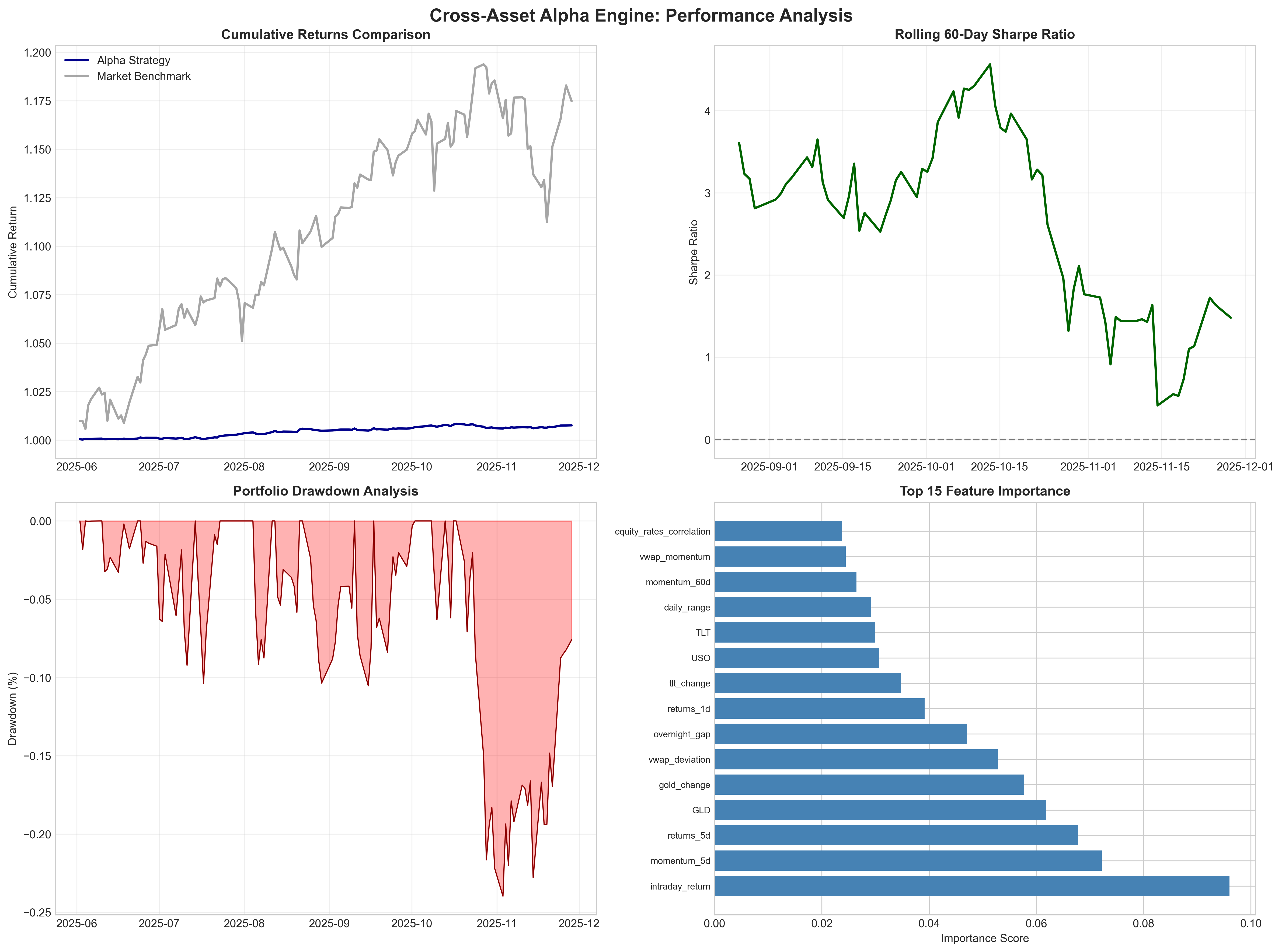
Feature importance analysis consistently shows that cross asset features rank among the most predictive signals, often outperforming purely technical indicators.

This figure highlights the dominance of cross asset and regime aware features in the model, reinforcing the idea that alpha does not live within a single asset class.
Regime Detection: Markets Are Not Stationary
Rather than assuming a single market environment, the engine explicitly classifies market regimes using volatility and cross asset stress indicators.
The current implementation uses a transparent quantile based regime framework, categorizing market states into:
- Low volatility regimes
- Medium volatility regimes
- High volatility regimes
While more complex approaches such as Hidden Markov Models are implemented in the broader codebase, they are intentionally excluded from the reported results to preserve interpretability and statistical defensibility.
Each regime represents a materially different trading environment, and the system adapts accordingly.
Alpha Modeling: Machine Learning, Used Carefully
Alpha prediction is handled through machine learning models trained separately within each regime. Random Forest regressors are used due to their robustness, ability to capture nonlinear interactions, and interpretability through feature importance.
Key modeling principles include:
- Strict time series splits with no data leakage
- Out of sample evaluation only
- Separate regime conditioned models
- Emphasis on stability rather than maximum returns
This approach prioritizes robustness across environments rather than optimizing for a single historical period.
Portfolio Construction: Market Neutral by Design
Predicted alphas are converted into positions using a disciplined portfolio construction framework. Position sizes are based on normalized alpha scores, capped to control single name risk, and adjusted to maintain near zero net exposure.
Key portfolio constraints include:
- Explicit position caps
- Gross exposure limits
- Near zero net market exposure
- Daily transaction cost modeling
Transaction costs are conservatively modeled at 5 basis points per side, and turnover is tracked explicitly.

This figure connects portfolio construction mechanics to realized performance, showing cumulative returns, drawdowns, and risk behavior.
Results: Modest Returns, Strong Risk Control
When evaluated net of transaction costs, the strategy produces modest but stable performance. Annualized returns are in the low single digits, volatility is similarly low, and drawdowns remain tightly controlled.
Key characteristics of the strategy include:
- Low volatility
- Small maximum drawdowns
- Near zero beta to the equity market
- Market neutral behavior by construction
It is important to note that the strategy underperforms a strong bull-market benchmark in absolute terms. This is expected and intentional. The engine is designed to provide diversification and risk adjusted returns, not to outperform equities during sustained rallies.
Statistical Validation: No Hand Waving
Statistical validation is treated as a first class component of the project rather than an afterthought. Formal Sharpe ratio tests show that risk adjusted performance is statistically significant, with extremely low p-values.
Bootstrap analysis is used to estimate confidence intervals for returns and Sharpe ratios. These intervals are reported honestly, including their width, which reflects the limited sample size.

The monthly returns heatmap provides a visual view of consistency and regime dependent behavior across time.
Return distributions are approximately normal, with mild positive skew and low kurtosis. At the same time, the project is explicit about what does not work: alpha persistence relative to the benchmark is not statistically significant, and the information ratio versus a strong equity benchmark is negative, as expected for a market neutral strategy during a bull market.

Limitations and Future Work
This project is intentionally honest about its constraints.
Current limitations include:
- Limited historical sample
- Daily frequency only
- Survivorship bias in the universe
- Quantile based regime detection
Future work will focus on extending the regime framework using probabilistic models, expanding the historical dataset, experimenting with alternative portfolio optimizers, and eventually deploying the engine in a live paper trading environment.
Final Thoughts
Markets are complex, adaptive systems. Strategies that ignore regimes and cross asset dynamics eventually fail. The Cross Asset Alpha Engine is a step toward building adaptive, risk aware trading systems using realistic assumptions and professional research standards.
This project is not about chasing alpha. It is about building systems that survive reality.